
From time to time on social media, I’ve seen authors displaying on their bio that they’re a ‘best-selling author’. In truth, anyone could label themselves with such a title. After some research about what constitutes being a ‘best-selling author’, I thought I’d share my thoughts on how it seems to be defined. I’ll talk about my own brush with the best-seller charts, what I learned from this, and what I think an author has to do to merit the coveted status of best-selling author.
King for a week…and a day
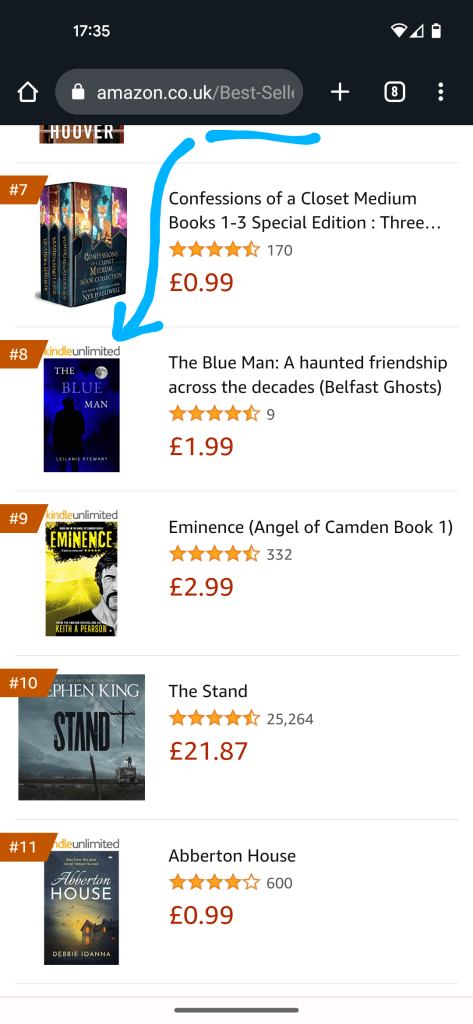
Two of my books have landed on Amazon’s best-seller charts in very different categories. Back in September 2022, my ghost horror novel, The Blue Man, reached #8 on Amazon’s Top 100 best-sellers chart for ghost horror on Amazon UK and stayed within the top 20 for 8 days. I sold up to 30 copies a day to land on best-sellers for ghost horror.
My poetry collection, A Model Archaeologist, has also landed on a best-seller list on Amazon CA, reaching #6 in British and Irish poetry. It stayed on the best-sellers chart for one day. I sold 3 copies for this to happen. Now, I can hear you say, ‘only 3 copies?’ and wonder ‘how on earth does this make a best-seller?

Category and competition matter
Ghost horror is a broad category, meaning I had to sell up to 30 copies a day of paid sales to land on a best-sellers list, as there is a lot of competition. On the other hand, British and Irish poetry is a tiny, niche category. There isn’t much competition, therefore my book landed a spot in best-sellers by selling 3 copies in one day.

Does that mean I’m a best-selling author?
No, it doesn’t. My books made it into the best-seller charts (hurray… happy dance!) but that doesn’t make me a ‘best-selling author’. I wouldn’t apply that term to my books for bragging rights as I haven’t earned the title. If your book sold enough copies in it’s genre, however niche, to land itself on a best-seller chart for an hour, a day, or in my case just over a week, then (well done, high five fellow chart topper! Now back to reality…) I’d say that like me, the answer is, no. You are also not a best-selling author. (Sad face. Let’s commiserate with an e-hug, shall we? Thanks, that made me feel better!)
So, what does makes a best-selling book – and author?
From searching around I haven’t found a precise definition, but the general consensus seems to be that having consistently high sales over a period of time, say 500 a week, for months on end and landing your book with ‘best-seller’ status from the marketplace where this was achieved would deem you a best-selling author. In other words, having a verified, approved label by the marketplace where you made sales as social proof that you are a best-selling author.
Are there other forms of social proof of best-selling author status?
Yes. If a book really has sold enough copies to be a best-seller then the number of reviews should reflect that. In my opinion, reviews aren’t official verification of best-seller status, but if an author claims to be a ‘best-selling author’ then I’d expect to see a minimum of 100 ratings and reviews to find their claim believable.
Is it misleading for an author to call themselves a best-selling author without merit?
In my opinion, yes, it is misleading. Now, you might say it doesn’t matter; what’s the harm? As an Indie and small-press author, I understand the need to do as much as possible to gain exposure for one’s books. But claiming to be a ‘best-selling author’ without merit does the opposite for me; it puts me off reading any of that author’s books. Whenever I look up an author and find that their book isn’t what they claimed, whether that is ‘best-seller’, ‘award-winner’, I consider that as false advertising and it puts me off the author, and their books.
The takeaway?
Whatever you do to advertise your book, make sure it isn’t misleading. If you have social proof of being a best-selling author by a merit from the marketplace where you gained that status, then by all means, use that to promote your book, as you have earned it. My eight day stretch on Amazon’s best-selling chart for ghost horror, sadly, doesn’t make me a ‘best-selling author’. The day may (or more likely, may not!) come when I sell enough books to earn a label from a marketplace giving me bragging rights as a best-selling author, but that accolade will be up to readers, and not me as the author, to decide.

 Leilanie Stewart