
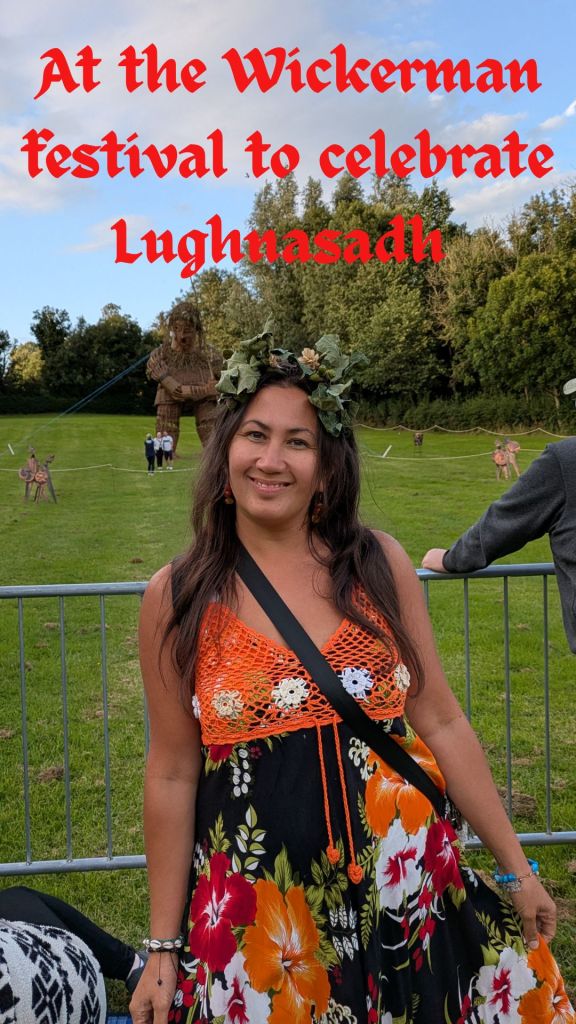
Yesterday I went to the Wickerman festival at Navan Fort, Co. Armagh in Northern Ireland. It was an amazing festival and fun living history event with Celtic battle reenactments that I had been wanting to attend for a number of years, but it had been cancelled due to covid and had only been brought back as of last year.

The spectacular burning of a 30ft willow and hazel effigy was a great end to the evening in a recreation of how the ancient Celtic people would have celebrated Lughnasdh, the start of harvest, in honour of the god Lugh. I made my oak and hornbeam headdress to represent summer (do you know the ancient Celtic battle story of the oak king versus the holly king?) and of course, brought along my books that include pagan rituals in the stories to share in the moment.
There was an article about the Wickerman festival in the Belfast Telegraph on Friday, which gave an interesting perspective from one of the weavers who created the effigy. It’s hard for me to imagine how it would feel to create an artwork intended to be destroyed. Even years ago, when I used to write first novel drafts longhand in a fancy notebook, I always typed up my writing after each chapter, therefore the risk of losing my work, or the notebook, wasn’t particularly high. Creating a work of art over the course of several months, only to see it burn in several minutes, would be emotional, but I suppose the satisfaction would come from the shared sense of community in an ephemeral celebration. Then again, that’s the whole point of the Wickerman festival; to recreate the community spirit of a celebration spanning thousands of years, connecting people with their pagan ancestors, and feel the collective excitement of the experience in a few minutes at sunset.
Certainly worked for me!

 Leilanie Stewart