

Do you want to know something really crazy? I have written five novel manuscripts (two of those published, one binned, one on submission and one forthcoming later this year) and it has only been a few months since I finished writing my most current novel work in progress (WIP#4, my supernatural horror), but I still find novel planning hard. It doesn’t get any easier, no matter how many books I write.
A friend recently asked me, on behalf of her daughter who wishes to become a writer, what advice I could offer about the writing process. This got me thinking about all that is involved in writing a novel, which is no small endeavour, let me tell you. Since it got me thinking about the process, I’m in the mood to be systematic, so let me share my experience with you.
1. Basic synopsis/premise
My first piece of advice is to always carry a notebook, as you never know when inspiration may strike. I have a dedicated notebook for all my novels and jot down any ideas, however great or rubbish they may turn out to be. Get it out of your head or you might well forget it. Now, what is the story about? Jot down a few sentences as a summary of your concept. You don’t even need to have decided on a title at this stage – work in progress is fine. As an example of the premise for my recently published novel, The Buddha’s Bone, I jotted down that a university graduate goes to Japan and is out of her element with culture shock and the language barrier. Of course, this story took a darker turn as the book unfolded, but my basic premise was about the main character navigating her new life in a foreign country.
2. Chapter planning
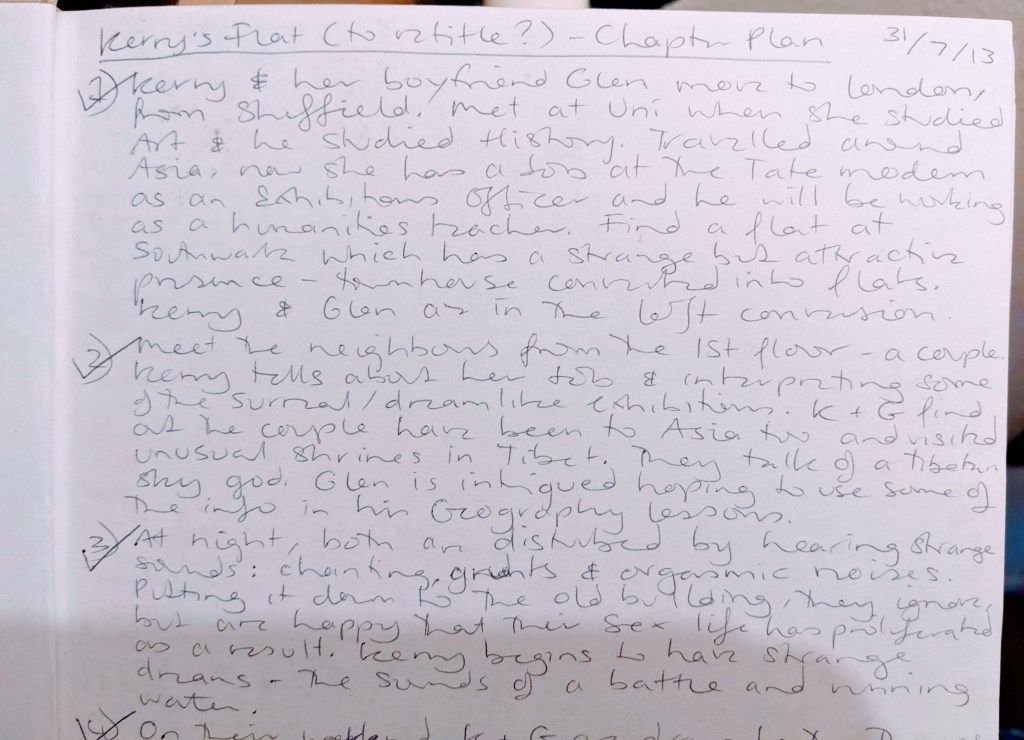
Once I’ve got my basic premise sketched out, I like to start chapter planning. I don’t always plan in order, but I try to jot down what I want to happen in each chapter in a few sentences. Leave gaps or a few blank lines under each title number so that you can write ideas later as your plot unfolds. Here’s a sneak peek into the chapter plan for my debut novel, Gods of Avalon Road, an urban fantasy/paranormal romance book, which started life with the working title, Kerry’s Flat:
3. Character development
What age is your main character and, if relevant, main villain? What is their job? What country/city/place do they live in? What is their primary motivation in your story? What do they look like and is their appearance relevant to the plot? I like to think that I know my characters as if they were real people. You should know things about them even if you aren’t going to use those details in your story; it gives your characters more emotional resonance in the book if you know why they react as they do.
4. Point of view/style
Are you going to write in first person (I) or third person (he/she/they)? I chose to write Kimberly in The Buddha’s Bone in first person as, being literary and psychological fiction, I wanted it to feel personal, almost like a soliloquy at times, whereas I wrote Kerry and Gavin’s alternating POV’s in Gods of Avalon Road in third person to capture the action. What about past tense or present tense? What fits your story best? Did it already happen, or is the reader experiencing it in the moment?
5. Research/notes
I like to flip to the back of my notebook to jot down research. For Gods of Avalon Road, I had to research occult rituals and pagan incantations. I also had to brush up my knowledge of the Roman occupation in London and life in ancient Britain. I took photos of artefacts at the British Museum and Museum of London and visited locations, timing the distance to walk between streets.

Once I have done all of the above, I like to get stuck into typing my first draft. A work in progress can change a great deal from the first concept to the finished manuscript, but if you have sketched out your ideas at every stage, you can use that as a checklist later. I tend to go back through my chapter plan later and write in red pen the date on which I finished each one, as this gives me a time frame later for my own reference. Hope all this helps you too on your own writing journey.

 Leilanie Stewart
We’ve written the same amount of manuscripts, and yes, it doesn’t get any easier. In fact, I get more stumped the more I try, lol. Am a pantser at heart, but I decided to try plotting during novels #3 and #5, and boy does it make things more confusing. Anyway, thanks for this post!