
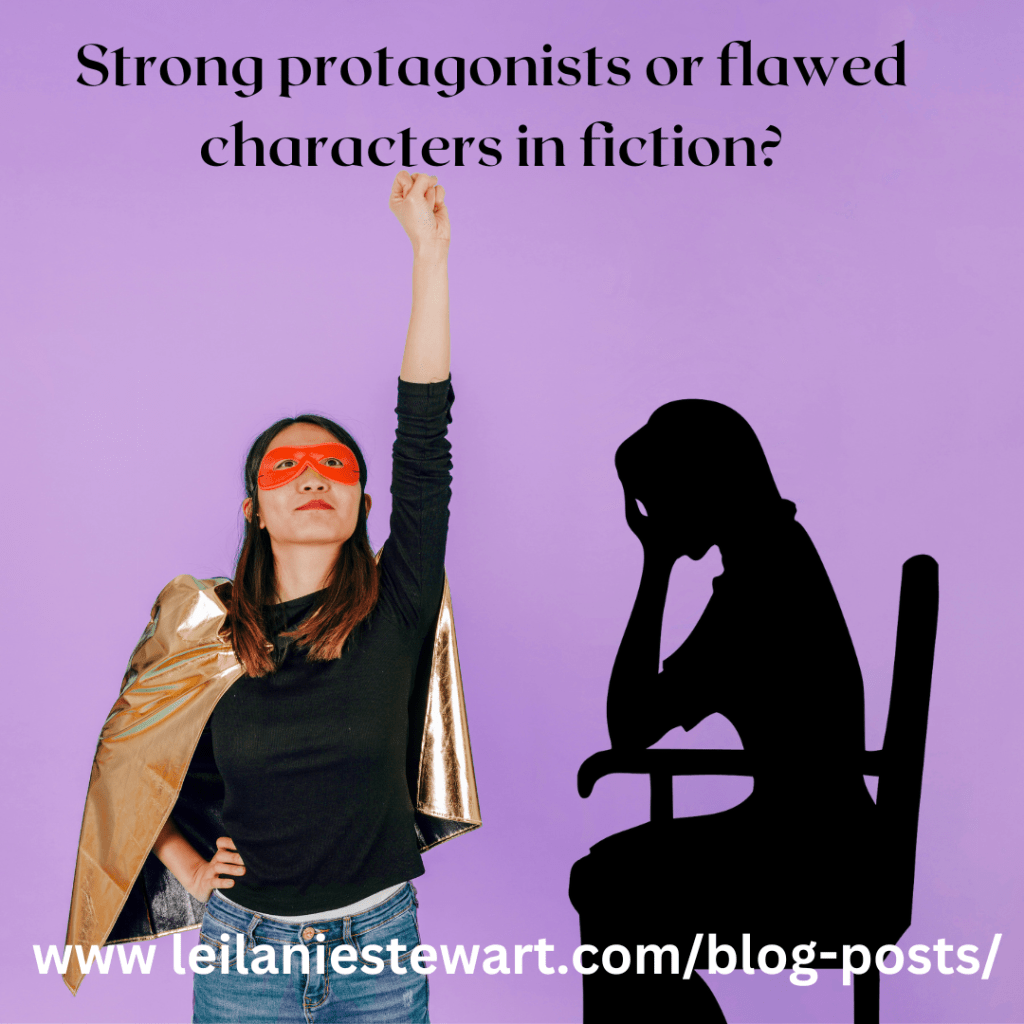
I had an interesting conversation with some bookish friends the other day about books we’re currently reading and we got onto the topic of how new books that we have recently read tended to have strong main characters, often ‘perfect’ or tough protagonists who can handle anything thrown at them. It was something that, admittedly, I hadn’t given much thought too beforehand, even as an author. Once I started thinking of this topic, it occurred to me that more often than not on social media lately, I had seen authors displaying their books with arrows and advertising labels such as “strong female lead”. It got me thinking about a few things, from a writing point of view, regarding protagonists in fiction, which inspired my blog post today.
Are strong characters relatable?
Clearly there is a need for strong main characters, or role-model types in fiction, since there is clearly a market for it. Personally, whilst I can see the benefit of a protagonist having positive traits, I don’t tend to gravitate to stories with strong main characters. If I’m honest, strong heroes or heroines in fiction don’t appeal to me, simply because I don’t think they’re realistic of the majority of people in real life, and therefore I don’t find such characters inspirational. As a reader, a character who is inherently perfect and deals with all obstacles in their path with ease is boring. As a writer, where is the room for character growth and development if a protagonist is already strong? No character arc for me means no story.
Flawed characters in an imperfect world
If I’m reading a book, I enjoy reading about flawed people who face considerable challenges, which force them on a journey of introspection. I like it when they succumb to their own darkness for a time, then change and grow as a result; or become consumed as a result of their own flaws. That’s much more interesting to me than any false and unrealistic ‘hero’. Let’s face facts: in real life everyone is flawed. How many of those people have overcome trauma? Lifted themselves out of adversity? Battled onwards despite devastating bad luck? I’d rather read about those people than some pretentious, perfect hero.
Strong characters in YA books versus adult fiction
Children need role models. They need to see people like themselves. They need to see how to navigate obstacles. But do they need a perfect, strong character to do this? I really don’t think so. To be flawed is realistic. Just as I feel imperfect people make great characters for adult fiction, I believe the same is true of YA books. When I was a teen, I related to the underdogs in stories; I rooted for them, not the little-miss-perfect who did everything right, was tough as all hell and a rock for others at the same time. I’ve never known any such people in real life, so such stories don’t provide me with any inspiration.
What do you think? Would you rather have a main character with flaws who could easily be from real life, or a ‘strong’ character who lives only in the realm of fantasy?

 Leilanie Stewart
I love me a flawed character. All of the characters I’ve written about are flawed, too.
I’d definitely pick flawed over strong any day. So much more interesting! ☺️