
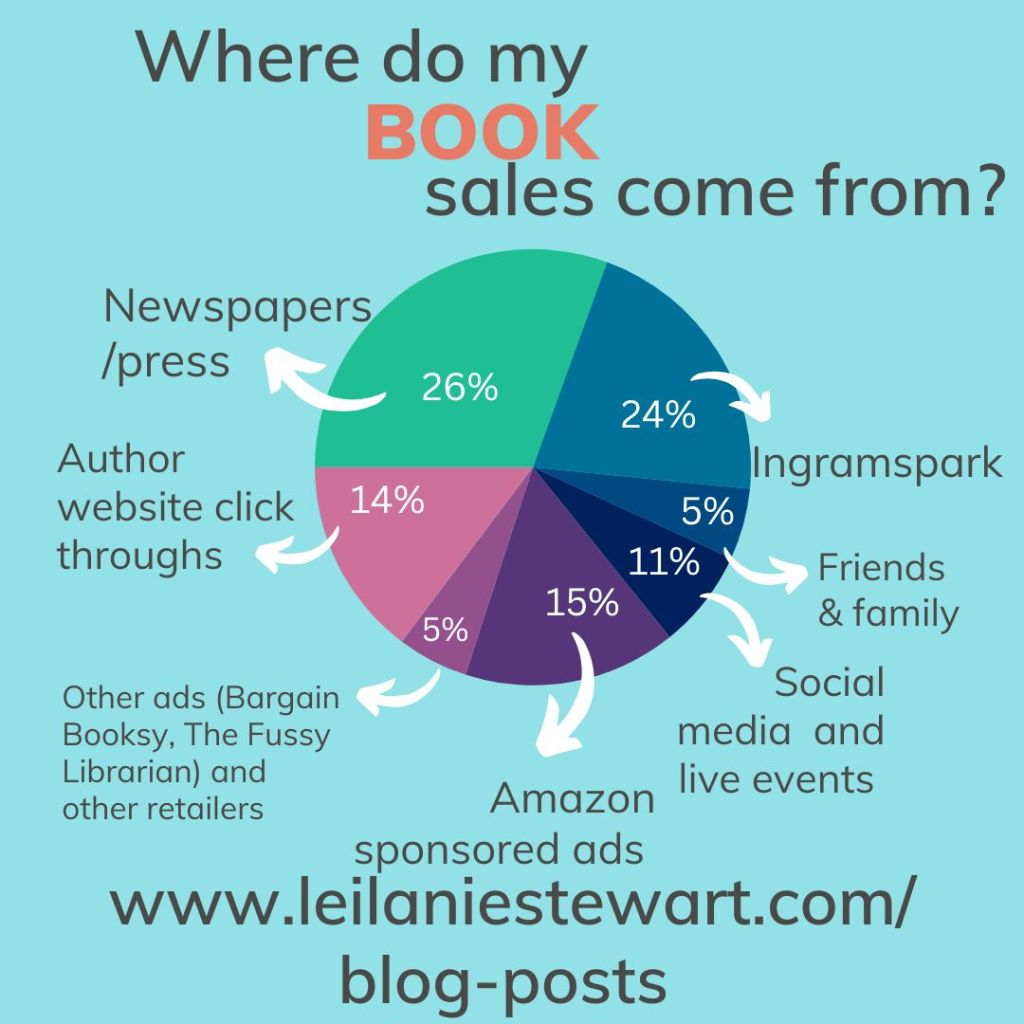
I was curious about all the avenues that lead to sales of my books, or Kindle page reads, and decided to tally up the figures over the last three years since I set up my own author imprint. The results make for interesting reading. If you’re a fellow author, you might be curious about your own sales, so I thought I’d share what I found, in case it might help others:
1. Newspapers/press releases (26%):
Getting newspaper articles written about my books in the Belfast Telegraph, Belfast Live and the Sunday World has undoubtedly driven sales by giving exposure to my writing. 26% of my sales have followed press releases in these newspapers. The sales, however, were limited to the weeks following the press coverage; this isn’t an ongoing thing.
2. Ingramspark (24%):
My hardcovers sell quite well. I wouldn’t say they sell steadily compared to my eBooks and paperbacks, but they definitely sell more than what I was expecting. There tend to be bulk sales when a new book releases, tapering off in the months afterwards. I guess readers must like them as collectibles. Approximately 24% of my sales since 2021 are from hardcover sales through Ingramspark. If you’re an author, I recommend using Ingramspark for your hardcovers; they are well made with sturdy materials and therefore look good on a bookshelf.
3. Amazon sponsored ads (15%):
Click throughs from my sponsored ads are my most steady source of ongoing sales, even though they make up my third most source of sales over all. I imagine that in the fullness of time, they will eventually become my first source of sales. I run campaigns for all my indie published books – I have no data for my traditionally published books, as all I get is a royalty statement biannually. It makes sense that steady trickles of sales come directly from Amazon ads, since if people are already on Amazon they are clearly there to do shopping.
5. Author website click throughs (14%)
9% of my sales over the past three years have come from click throughs to Amazon US and Amazon UK via my website. I know this because I can track the sales or page reads on KDP. Likewise, I’ve seen a few spikes after promotional features such as prize wins for my books and book blogger websites.
6. Social media and live events (11%)
I’m only able to track sales from people on social media who have posted comments that they have bought my books; the number of sales could be higher. I don’t do too many live author events these days, as I find it’s a better use of my time, and more marketable, to put my advertising budget, and promotional energy into selling online.
7. Family and friends (5%)
Friends and family have made up a small portion of my sales – 5% of sales over the past three years. Some of my f&f promote my posts instead, but don’t necessarily buy my books.
8. Other ads and other retailers (5%)
Selling through paid ads on Bargain Booksy and The Fussy Librarian has generated a trickle of sales, but I have spent more on the ads than I have reaped back in readers and royalties. I imagine authors of genres such as romance or crime fiction may yield better results through these sites. Sales on other retailers through Gardners also make up the 3%. I guess most people shop on Amazon – at least where my books are concerned.
In summary
Working out these stats was rather illuminating. I had to go through my sales tracker over the past three years and I made tallys according to the categories above – then out of the total sales, worked out the percentages. Interesting stuff. If you’re an author, do you keep track of where your sales come from, or are you more interested in just reaching readers in general, regardless of the avenues that lead to those sales? Feel free to comment, if you like, and I hope my own stats were helpful to you.

 Leilanie Stewart
Interesting. I published books on Amazon and they are there but I have no idea how to promote them. I mainly wanted to write a book and I did.
Thanks for reading, hope the post was helpful. 🙂