
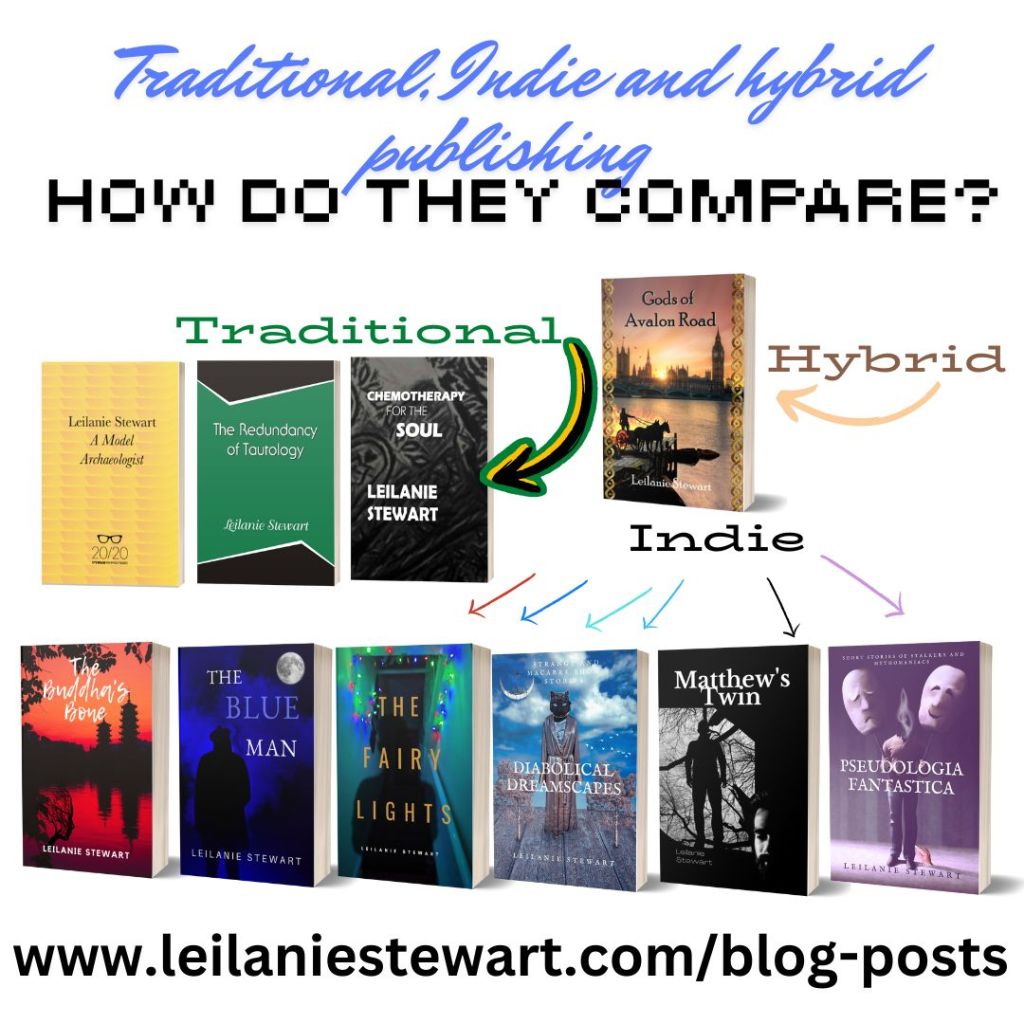
Usually when an author starts out on their publishing journey, they might begin with self-publishing their book to build up a few reviews and develop a readership, before approaching a publisher and following the traditional route to publication. In my case it was the opposite. In this post, I’d like to share with you my experience of being an author starting on the traditional route, before moving to hybrid publishing, and finally launching my own Indie imprint. Here, I’ll share with you my thoughts on which route might suit certain authors based on their circumstances.
My publishing journey began
Back in 2009, I started building up my literary CV by submitting my short stories and poetry for publication in magazines and anthologies in the UK and elsewhere worldwide. I had read in the Writers and Artists yearbook, and similar writing advice magazines and books, that in order to get the attention of a publisher or agent, the best way was to build up a literary CV.
My journey down the traditional route
With a dozen or so reputable print and online magazines on my writing CV, in 2013 I submitted my first poetry chapbook manuscript for consideration in the 2014 Melita Hume Poetry Prize. Although I didn’t win, I was longlisted, and on the basis of this, I was offered a contract for my debut poetry chapbook of 25 poems, which was published in June 2015 (after 5 years the rights reverted to me and I have since republished the full 80 poem collection of A Model Archaeologist under my own imprint).
Although traditionally published, I didn’t get any advance, as they were a small press publisher, but I was thrilled to have a contract nonetheless. I had no control over which poems out of the 80 poem manuscript were selected for publication, nor any say in the cover design, but I did have some say about final checks, to make sure the overall tone of my poems wasn’t lost in the editing process.
Having a published book to my name was all that mattered. I didn’t delude myself that I’d be rolling in royalties; indeed, I found myself doing the legwork to sell my books at literary events across London. I participated in the Hammersmith and Fulham Arts festival, sold copies at the Free Verse Fair in London, and my publisher held a launch party at the Rugby Tavern in Holborn. But I found that after an initial flurry of activity, the books simply weren’t selling unless I kept promoting myself nonstop at live events such as open mic nights, book signings and other literary fairs. Online sales were virtually nil. At this stage, I began to focus more on trying to get my fiction out into the world, as I wondered if maybe the poetry route in publishing was perhaps a bit too niche.
My foray with hybrid publishing
Hybrid publishing was the bridge I was looking for to dip my toe into the world of novel publishing. Back in 2019, I felt I didn’t have the publishing skills to typeset my own manuscript, nor did I possess the relevant graphic design skills to produce my own cover. I was getting frustrated at the long (so long!) response time with traditional publishers, who would often reply to an initial 3 chapter submission after one whole year – with a rejection. In addition my then-toddler meant I didn’t have the time or energy to properly pursue either traditional or Indie publishing.
Lo and behold I found the perfect medium; a hybrid publishing contract. Essentially the publisher offered traditional contracts for more established authors, and hybrid contracts for new authors. Since I was looking to publish my debut novel, they offered a hybrid contract. Their response time was quick. I was required to pay a ‘token’ fee towards book production costs while my publisher funded the rest. I had more creative input with the cover design than when traditionally published, and was able to choose from 3 sample cover designs. I also had a chance to check the final typeset manuscript before publication. I had no say over the pricing, or date of publication, and my request for the book to appear in Kindle Unlimited, to widen readership, was ignored.
Nevertheless, my debut novel Gods of Avalon Road, was published in 2019. As before, I put all my efforts into promoting my book, holding a Waterstones book launch, library promo events and advertising widely on social media.
The road to Indie publishing
Over time, I began to get frustrated that I had no control over setting price promotions on my books that had been traditionally or hybrid published. Listing them in Kindle Unlimited, or dropping the price at seasonal times of year seemed a good basic marketing strategy to keep generating interest that I felt my publishers weren’t utilising. Furthermore, after the initial book launch, my publishers didn’t actively promote my books. I was having to do all the active ongoing promotion, while only receiving 10% on traditionally published, 35% on paperbacks and 50% royalties on ebooks. I soon began to think about Indie publishing (self-publishing) and specifically about setting up my own imprint. It seemed to me that since I was doing so much active promotion, why not do it all myself and retain 70% of royalties – on net royalties, not costs.
Setting up my own Indie publishing imprint
I began to watch tutorials on how to typeset a manuscript; how to upload it to KDP and Ingramspark; how to go wide or exclusive; how to set competitive pricing; how to design an effective book cover – and so on. I bought my ISBNs from Nielsen, got myself registered with the IRS in the US for tax purposes and set up my own imprint, Leilanie Stewart books with the British Library. Finally in 2021 my Indie author career had been launched.
Traditional, Indie or hybrid publishing – how do they compare?
Which is best, many a person has asked. It really depends on what you want, as an author. While for me, and my experience so far, Indie publishing has been by far the best, in terms of satisfaction with the book design process, as well as sales and royalties, it’s a very involved process and incredibly time consuming.
Who suits Indie/self-publishing?
If you are happy to have full creative control, and have the time, skills and energy to do so, then Indie publishing would be the most rewarding for you. There’s much to learn about book production, and I’ll be honest, marketing is still a mystery to me 3 years after launching my Indie imprint, but I’m selling more books than I did when I was traditionally and hybrid published, so it’s well worth the learning curve. Plus, I reap the benefits of having 70% royalties.
Who suits hybrid publishing?
If you want your book to come out relatively quickly, say within a year, and are happy to hand over most of the creative control in terms of the cover design and book production, but maybe still having some influence over the final touches, then hybrid may be the way forward for you. It allows you to dip your toes into publishing without needing to do the bulk of the initial production work; I’d recommend this for those not quite ready to go it alone in self-publishing, or for those with other commitments – such as folks with young kids, or those studying or with demanding day jobs. Hybrid publishing suited me while my child was still very young and dependent on me, at a time when I didn’t have spare energy to either self-publish my work, or keep submitting sample chapters to traditional publishers. The royalties are generally higher than traditional too; usually somewhere between 35-50%.
Who suits traditional publishing?
This would suit writers who are willing to wait a long time for their book to be published; often more than a year, and have a thick skin to deal with rejection letters – lots of them. But, if all goes well, and depending on the size and reach of your publisher, your book could potentially do very well – in which case the 10% royalties would pay very nicely. Bear in mind that you’ll still have to actively promote your book; having a publisher doesn’t necessarily mean they do all the marketing.
In summary
At the end of the day, it’s up to you and what would suit your author career at any given time. I found that at different stages of my career, each one of the above publishing options suited me. I previously wrote a similar blog post about traditional, hybrid and self-publishing three years ago, and my opinion has changed since then. It may well change again. In fact, for one of my current WIPs I’m actually planning to submit it traditionally to mid-size publishers who I feel might have more reach than I do as an Indie author at present. I’ll keep you in the loop of how that goes, when the time comes. In the meantime, hope today’s post was helpful, and feel free to share your thoughts.
If you want to read about a bestselling author who started with a publisher and self-published her third novel, check this article out here.

 Leilanie Stewart
An interesting comparison. I’m happy as an indie, although it’s been a steep learning curve in terms of marketing. That was really all I wanted from a traditional publisher, but more and more I see that they actually do very little for many of the books they take on – their budget is mostly used on those books from which they envision the highest financial return. I’m happy therefore that I have total control over my own output, even though selling my work is an uphill struggle. If I don’t market it’s down to me, rather than my having paid for something which isn’t provided. Thanks for the post. 🙂
Marketing is definitely the hardest part of being an Indie, but I have to say I enjoy the trial and error of it too. I totally agree that publishers push the books they think will sell the most, and I also found from my experience that they quickly move onto the next book and new author, so the fanfare around a book launch is quick lived. Whether trad, Indie or hybrid, it seems the bulk of marketing is now down to the author anyway.
Agreed – so best to keep control of how it’s being done, along with every other part of the writing/publishing process. 🙂
So if I want to get the attention of a literary agent for my book your advice is to build your literary CV. I assume this means submit, submit, submit. But I’ve heard that just isn’t done anymore. That you must have an agent. Perhaps, the American publishers are different. What advice can you give a humble writer such as myself? I’ve had many people from various backgrounds praise the bits they’ve seen but I’m at a loss as to what to do once it’s finished.
Hi Eleanor. It isn’t my advice; as mentioned in my blog post, this was the advice I read in the Writers and Artists yearbook way back in 2009 when I was first starting out as a writer and submitting to publishers. Nowadays I run my own publishing imprint. If you’re going down the traditional route though, my advice is to be patient and develop a thick skin as it can take years to get a publisher and there will be more rejections than acceptances along the way, so don’t get disheartened. Best of luck with it too. 🙂