Writing and working a day job

A writer’s ideal world would be making enough money from their writing to write full time and give up their day job. I’ve seen countless writers say this on blogs or writing forums, but what’s the reality? It seems the odds of ‘the big break’ are about the same as winning the lottery! That’s not to say all of us writers and poets out there must despair. Quite the opposite, actually.

A blurred line between day job and writing...

A blurred line between day job and writing…

A good day job doesn’t necessarily have to affect writing time. It really depends on what you do. I’ve read a lot of famous writers’ bios and most of them took the route that I think is best to maximise writing time: working in a school. I had a lovely 6 week break from the end of July and cranked out quite a lot of work during that time. Now that I’m back for autumn term, it doesn’t have to be all brown-leaves-and-winter-despair, to get poetic with it all. Setting goals helps and making time to write, not finding time. If you wait for time to come to you, you’ll be lost amidst all those blank pages – forever.
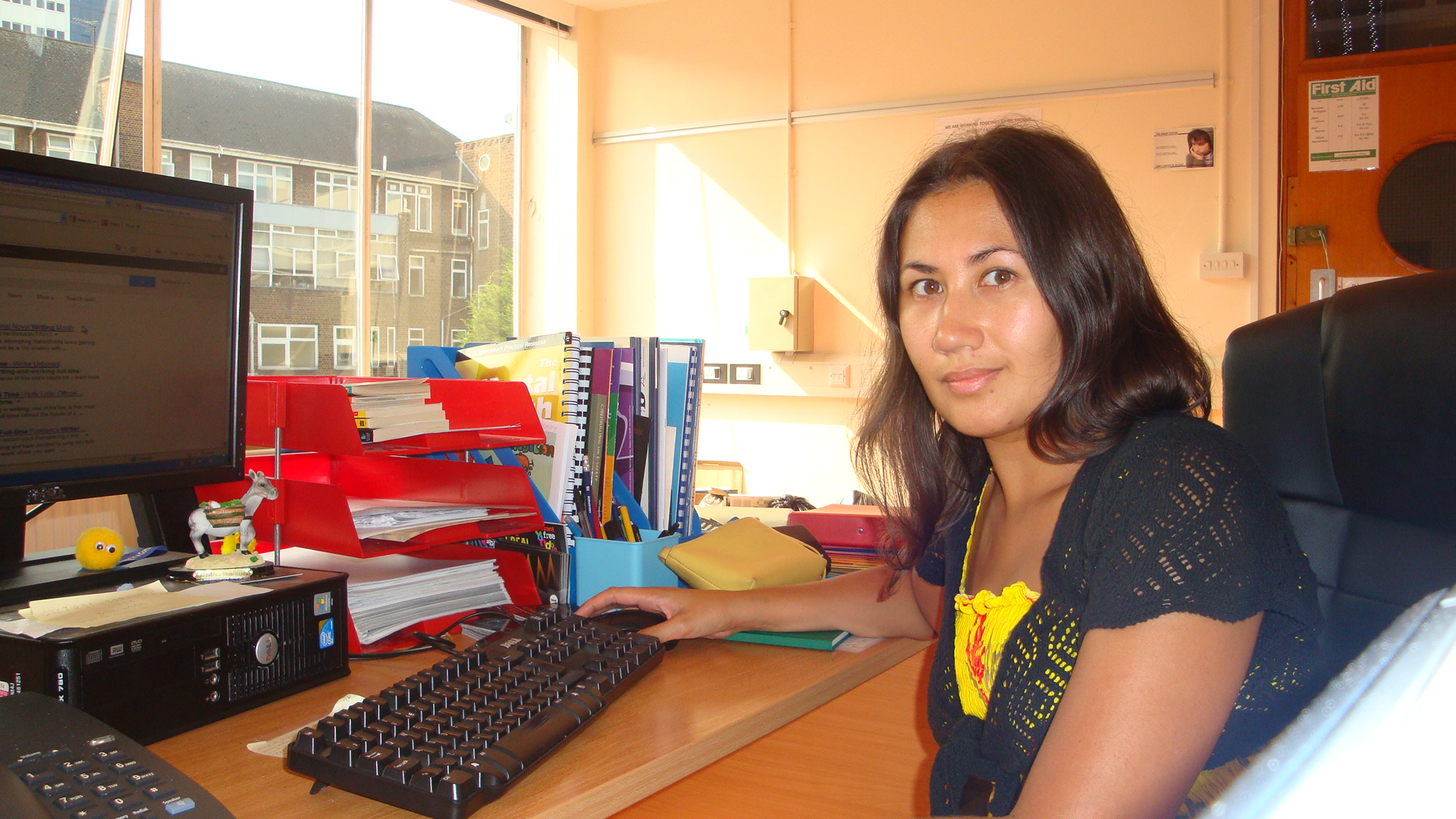
...can be fixed by working on your lunch break!

…can be fixed by working on your lunch break!

Of course, it’s a fine balance. You have to do your day job, first and foremost… the bills won’t pay themselves (I wish). And you can’t ignore your colleagues. One too many times, I’ve been caught up in my writing with my headphones on and being completely anti-social. Juggling writing with a full time job takes balance. Anything extra is a bonus. As for me? I count myself lucky that I can do what I love at work and after – running my young writer groups by day and writing alongside my partner-in-rhyme (I apologise for the terrible pun!) Joseph Robert by night. After all, a writer writes, then eats and sleeps (often in that order). Remember to get up for stretches regularly, all you type-a-holics. And for those of you who write longhand – don’t get knuckle cramps. I speak from experience here; I had a productive summer, since the mind is always willing, but sometimes the body can’t cope!
Farewell Seamus Heaney and Jenny the Elephant

Sad news for the poetry world today; the death of Seamus Heaney. Heaney was also from Northern Ireland (depending on what way you look at it – after all, some would say he was born in Derry and others would say Londonderry, but I’m not about to argue semantics). I haven’t read that much of his work, although my favourite poem so far is ‘The Early Purges’, which when written I’m sure wasn’t as controversial as it might be perceived today – we now live in a politically correct culture that on the one hand is good (equality for all, right?), but on the flip side has choked the freedom of expression out of cinema/literature, to some extent. I could digress in a million different directions with all this, but let’s stick to the poem for now – animals being drowned in rivers and people turning a blind eye. You can’t say it’s not gritty.

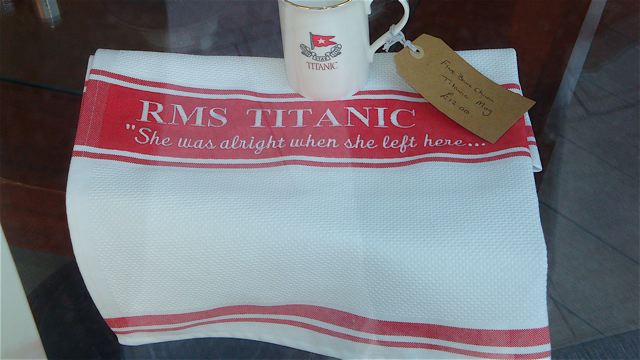
There are many writers and poets from Northern Ireland, but Seamus Heaney is probably the most famous. Northern Irish people in general definitely have a sardonic sense of humour – from chip shops called ‘For Cod and Ulster’ to the new Titanic Museum’s slogan, “She was alright when she left here”:

Titanic slogan in Belfast

Anyway, back to famous figures from Northern Ireland dying today, on August 30. According to the Belfast Telegraph, Jenny the elephant from Belfast Zoo has also died, aged 53. Not quite the ripe old age of 74, but then I don’t know how elephant years correspond to human years. I’m sure Seamus Heaney would be proud to know that – I would. Or maybe not. Check out his poem, ‘The Early Purges‘ and see what you think.

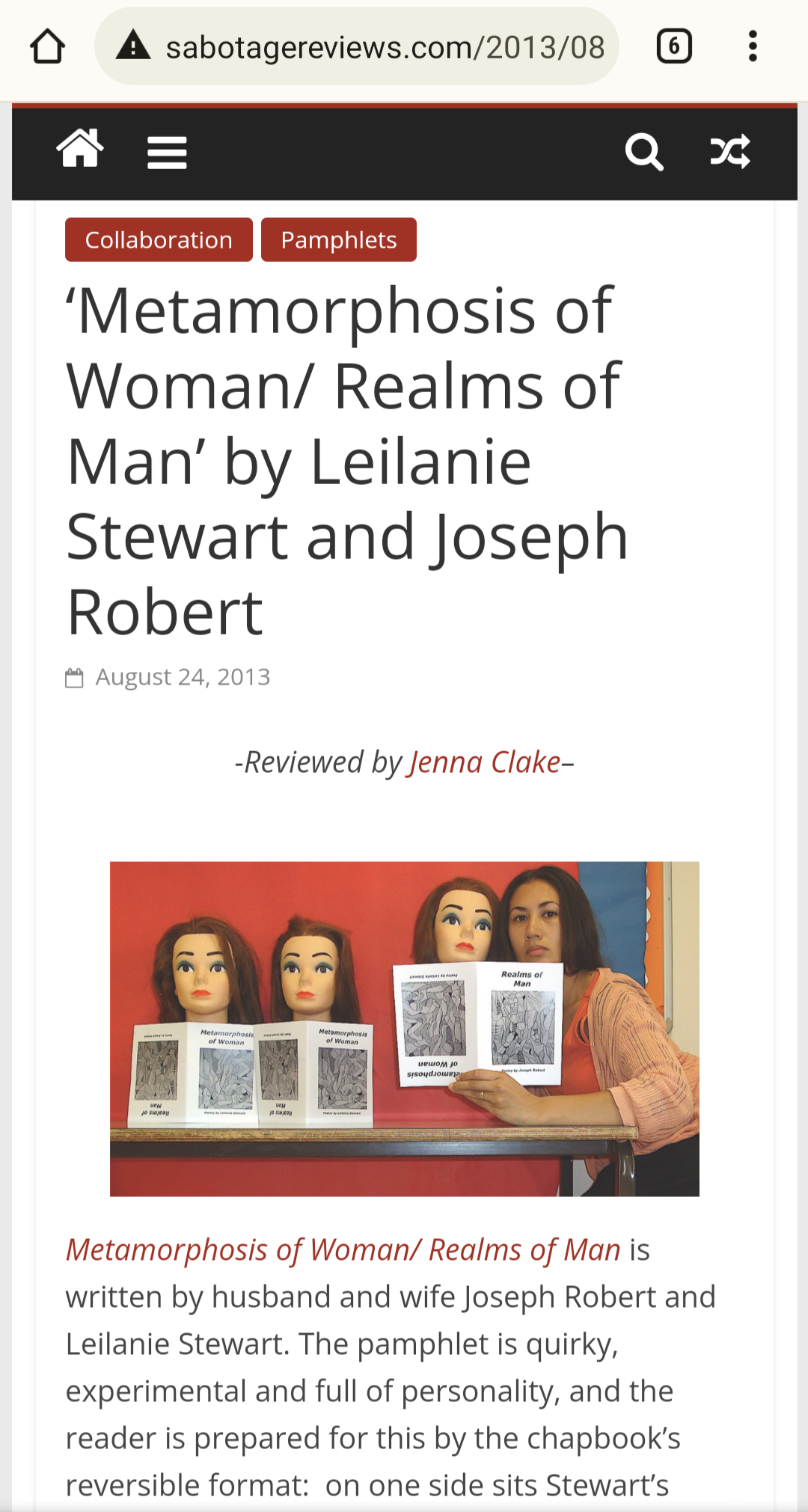
Joseph Robert and Leilanie Stewart – chapbook review in Sabotage


This month Joseph Robert and I had our joint collection, Realms of Man/ Metamorphosis of Woman, reviewed in Sabotage. The incisive and detailed review by Jenna Clake concludes with: “It is evident why the poets have chosen to self-publish collaboratively: their work shares enough similarities to make the pamphlet seem unified, without one over-shadowing the other or the work blending into one undefinable collection. Metamorphosis of Woman/ Realms of Man is a largely successful pamphlet, and it is entertaining at the very least.”

Jenna Clake also reviewed my other chapbook, Toebirds and Woodlice for Sabotage, which you can read here. She noted: “What is most striking about Stewart’s Toebirds and Woodlice is its difference to her other pamphlet, Metamorphosis of Woman. Granted, the strong, honest personae are still there, but this time, Stewart is concerned with the mind.”

The same reviewer, Jenna Crake, also wrote about self-publishing in Red Brick, describing it as a ‘revolution’. I have written my opinion of self-publishing in one of my earlier posts, and I would have to agree. The transition to ebooks has taken off over the past few years; it’s easier now than ever before for a first time author to skip the hassle of submitting via snail-mail to agents and publishers (never mind the fact that things can often go astray in the post – in one case the return of a manuscript that had never reached its destination, having sat in head office for one month, grr!). But, self-publishing can be a double-edged sword. As I mentioned before, there is no quality control; without any submission guidelines or editors checking the manuscript, you have to dig through a lot of coal before you come across any diamonds. There aren’t too many who can be bothered for that, on top of needing a day job to pay the bills. Such is life for us carbon- based life forms! Still the nature of self-publishing can be a rewarding one. We can’t take anything with us after we die (Long, hard sleep, anyone?), so we might as well reap the benefits of a good old slog!

Mistress Quickly’s Bed Issue 4

This week among other things, I’ve been reading Issue 4 of Mistress Quickly’s Bed. There’s an overarching theme of religion that I picked up on in the issue, first of all in the editorial where the publishers, Alan Dent and Nancy Frost, conversed about how they think that religion is just a phase, rather like E.L. James (lol!). Of course, as much as I’d like to agree with them (after all, what has caused more war and death in the world) as a former archaeologist, unfortunately I can’t deny that religion has come hand and hand with the dawn of civilisation and temples have controlled the nature of society since the days of city-states like Eridu, 6000-odd years ago. Society and religion (sigh!). My favourite poems in this issue were by poet Rob Brady…I felt much the same way he did as a child in his poem ‘Theology’ on page 20, although my favourite poem of his has to be ‘Democracy’ on page 18. Yes, people pay taxes and yes, soldiers fight wars that they often don’t know why they’re fighting, but what about the title, democracy? I can think of another word beginning with D that I reckon sums up society to a T!

Mistress Quickly’s Bed, along with Inclement, Decanto and Sarasvati are among my current favourite print poetry journals. I especially love the bite that the editor of Mistress Quickly’s Bed, Alan Dent, has. The last page of the summer volume finishes with a fantastic invitation for writers standing in the face of publishing despair to learn in a seminar from Franz Kafka about what exactly is on the line when you put your sanity versus every publisher in Europe. Love it!

About this blog

Leilanie Stewart

Joseph Robert

Manga and comic books – getting the kids to read

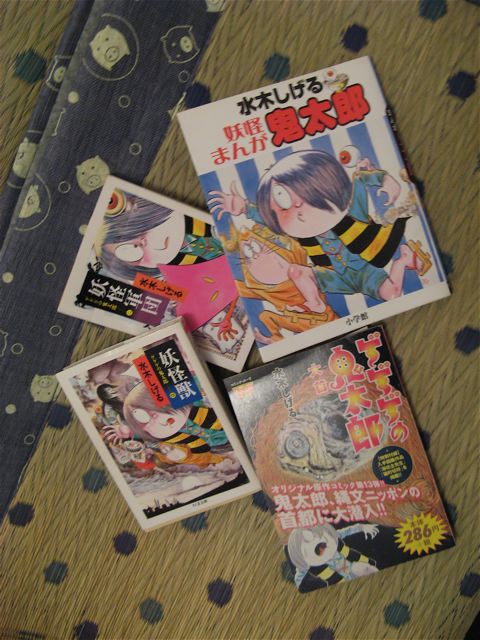
When I worked in Japan years ago as an English teacher, I happened to get into Japanese manga by accident. I was renewing my work visa for another year at Sakaiminato, a tiny port on the North West coast of Japan and while I was waiting for my train home I browsed in the newsagents at the station. As any ex-pat who has lived in Japan knows, you can only really buy English language magazines, newspapers or books in big cities such as Osaka and Tokyo. Since I was studying Japanese at the time anyway I decided to pick up a paperback copy of what looked to be a weird little horror comic book (Japanese manga). The comic was called Ge Ge Ge no Kitaro, about a half-Goblin, half-human character called Kitaro from Ge Ge Ge forest. Anyway, it was by a local author in Sakaiminato, quite well known in Japan, but not in the West. As it happens, I found the comic to be a great way to learn Japanese, since the pictures aided my studying and the kanji characters were translated into furigana (for the purpose of Japanese schoolkids who don’t yet know all of the Chinese script). Roll on 7 years later and the comic has finally been translated into English. I found a copy in a central London comic book store just last week.

My favourite manga series... ge ge ge no kitaro

My favourite manga series… ge ge ge no kitaro

Apart from being a great source of literature for people wanting to learn a second language (nursery rhyme books are great for this too!), manga is a great way to get kids back into reading. A few months ago, I worked with an 11 year old girl who was having problems with her literacy. She was below her age for reading and spelling and was bored of any books recommended to her. She’d pretty much given up on reading for fun at this point. After a few one to one sessions with her, I found out that her main problem was being shy about asking whenever she encountered a new word. In a class of 30 kids in school, who could blame her. In our sessions I set her the task of trying some manga. As she was a girly girl, I started with D N Angel – the teenage girls at my school are crazy about the love triangle in the series between Dark, Daisuke and the twin sisters. Anyway, this not only helped her reading comprehension but her concentration too – little and often with lots of pics. She ended up loving the series so much that she read the first 15 books in a week!

Manga, comics, graphic novels… it’s all the same to me. The boys I work with love Naruto. They find it amusing when I correct their pronunciation of the Japanese name, of course – it should be Nah-roo-toe (short and succinct) instead of Na-ROO-toe with the emphasis on the middle as they say it… wrong, wrong wrong!

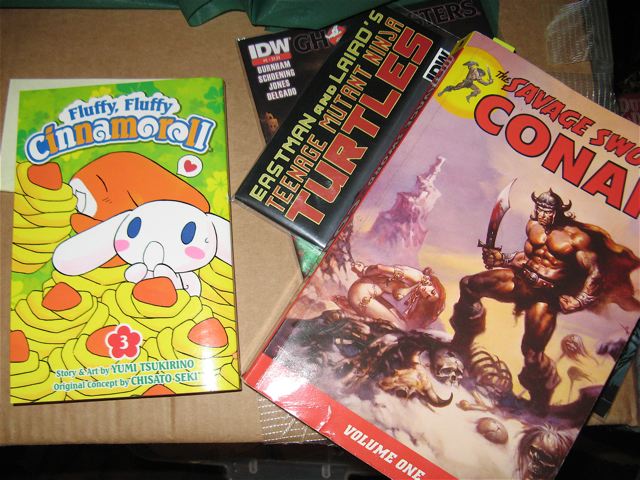
As for me? I’m reading real high art at the moment (tee hee)… Cinnamoroll. He’s a cutesy, fruitesy wonderpup from the sky. Aw!

Cinnamoroll, Conan, The Turtles and Ghostbusters... it all makes for a good read!

Cinnamoroll, Conan, The Turtles and Ghostbusters… it all makes for a good read!

About this blog

Leilanie Stewart

Joseph Robert

Supporting small bookstores and small presses

What to do when you’re book shopping:

1. If it is a thick book, rap on the front cover to hear that lovely deep ‘thunk’.

2. Open it up and smell it. New books have their new smell, second hand books have their well-loved scent.

3. Buy the book! Support small businesses! Don’t let them close in the face of online retailers. Don’t be one of those people who browses in stores, then puts a dog-eared book back on a shelf and buys a new copy from Amazon. Amazon is great for obscure or out of print books, but don’t forget your local bookstores!

4. And the same goes for magazines. You don’t get the lovely ‘thunk’ sound as they’re not thick enough to make it, but when I’m on my morning commute, I prefer to have a poetry magazine or a physical copy of a book that I can read. Yes, my ipad is great and I have a ton of books downloaded on it, but call me old-fashioned… I’d still rather root around in my bag for a good old paperback or a nice past contributor copy.

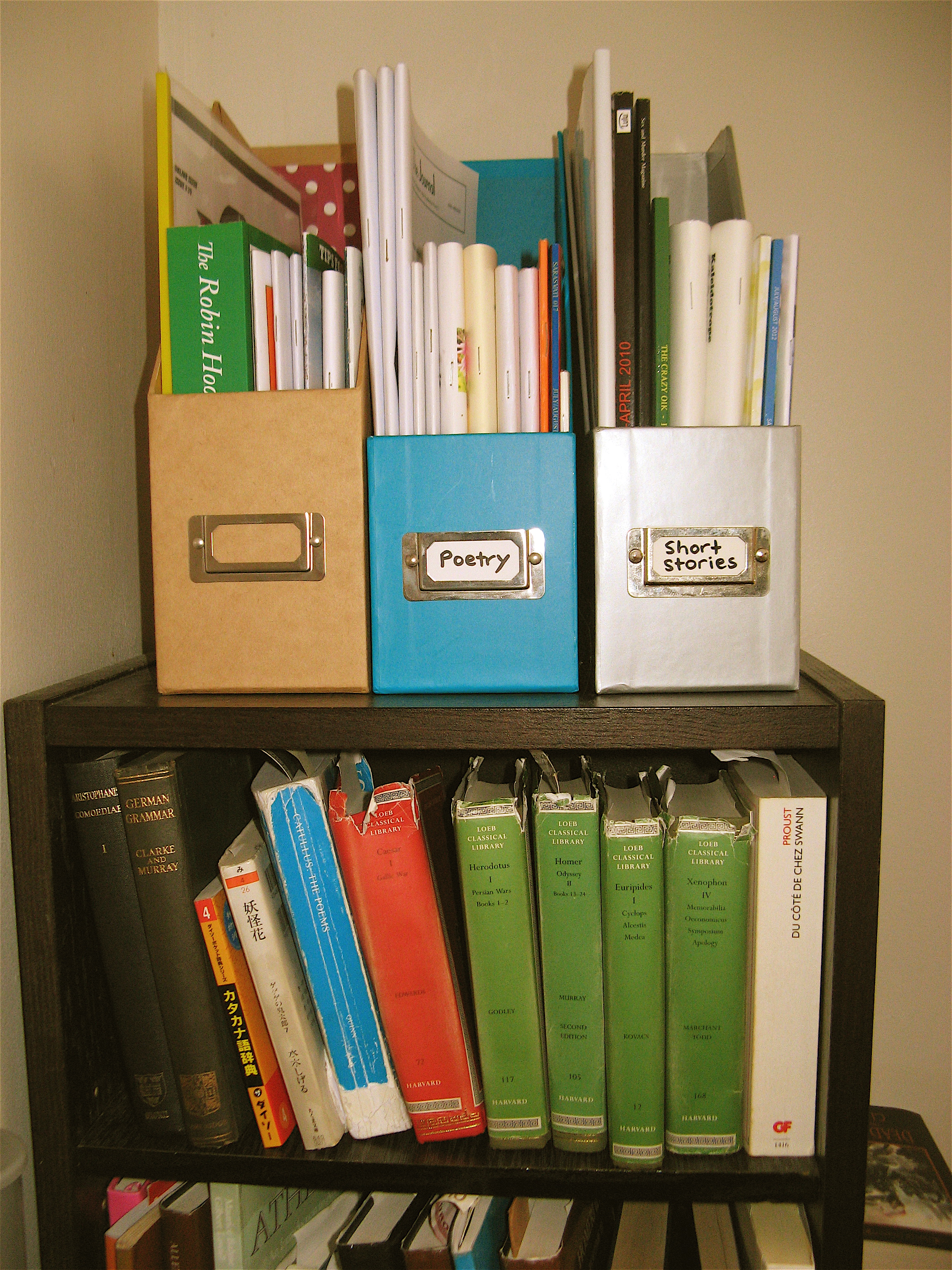
Contributor copies. If I had the means I would subscribe to more small presses, more often. Instead, when I catch a moment I like to read through past contributor copies of favourites… Decanto, Sarasvati and some newer ones like Mistress Quickly’s Bed.

Contributor copies - poetry, fiction and both.

Contributor copies – poetry, fiction and both.

A debut author in a debut age of publishing

Here are the facts about traditional publishing as I see them: in a world of tough economic times, big publishing houses are sticking to the safe and familiar rather than going with the new and risky. And in this fashion, a ‘new’ author comes out with a crime novel, which manages to move around 500 or so books. Of course, the author’s name is revealed to be a pseudonym and the real writer is unmasked… add another 0 onto the end of the 500 and the 5000 figure represents the number of books moved in a few hours after the big reveal. And, well you’ve read the rest. It’s been interesting to hear the views of upcoming writers who have expressed a sense of relief that their debut sales of around the 500 mark were normal and comparable with a hugely famous author under a guise.

It goes to show that most readers nowadays would rather stick to a famous name than try out a novice. As for me, unfortunately most literary debuts can’t hold my interest for more than a few minutes anymore – they aren’t challenging enough and most contemporary poetry in Foyles or Waterstones isn’t interesting enough for my taste. The Southbank Poetry library is keeping the real poetry scene alive, IMHO, and as for novels… when I’m out book shopping, I’ve reverted to buying classics, genre fiction and good old non-fiction, in the ‘interim’. Let’s hope the traditional publishing industry doesn’t stagnate too much, as this poor bookshelf did.

Stagnation: Is this to be the way of traditional publishing?

Stagnation: Is this to be the way of traditional publishing?

Poetry readings and reading prose

During the last couple of weeks, my young creative writers have been more than enthusiastic about reading their poems to primary school children across London. I was impressed by their improvisation skills as well as their bravery, since a few even adapted one or two lines to suit their audience (like toning down their worries about coming to secondary school and focussing on the fun).

My young writers reading their poetry to primary school pupils

My young writers reading their poetry to primary school pupils

Reading to an audience takes practise, skill...and sometimes improvisation!

Reading to an audience takes practise, skill…and sometimes improvisation!

It got me thinking about my young writers last year, who did a mix of poetry and stories. Stories are harder to read to an audience. Besides having to choose a short one, so as not to take up half the day, the rhythm of poetry makes it easier to read, even when reading free verse. When I’ve read some of my stories to an audience, I’ve found that I’ve had to breathe mid-sentence, creating a pause where on paper there wouldn’t necessarily be one. Of course, a lot of people are better at acting than me and can go the whole distance without so much as a hesitation! Reading to an audience is performance – a better skill would be to have the poem or story memorised. I’m still working on this myself!

Poem not in me – a poem by Joseph Robert

Spinozablue published another of Joseph Robert’s poems, Poem not in me, at the start of this month. The beauty of a poem is how an individual interprets it. The editor of Spinozablue, Douglas, added a short review of Joseph’s poem in the form of a tag: The Poem Inside. Poem not in me or The Poem Inside… the first is empty, the second full. Or, the third: the poem as a mirage, a fleeting moment that is ever on the horizon, ever evading being captured.

Interpretation - the first, the second, or the third?

Interpretation – the first, the second, or the third?

Joint Publication in Mudjob

Joseph Robert and I are celebrating summer with a joint publication in Mudjob Magazine. Apart from our own reversible chapbook, Realms of Man/ Metamorphosis of Woman, this is the first showcase of our work together. The editor of Mudjob, Michael, had the great idea for a double feature as he found the writing couple idea of interest. As I said in my last post, writing is a solitary process, but there’s no reason why the publishing and promotion side of the craft should be!

Optimistic - enjoying the summer

Optimistic – enjoying the summer

Summer… does that mean we are living on the wrong side of the solstice, or the right side? The wrong side means you are focussing on the days getting shorter. The right side means you are enjoying the warmer days, living for the moment. In Britain, isn’t it better for us to think about the evenings staying light until 9PM, rather than wondering if tomorrow it will get darker that little bit earlier? Are you dwelling on yesterday being officially the hottest day in England so far, or are you thinking that the days will all be cooler from now on? For all you pessimists out there, my advice is to take it one day at a time. Leilanie Stewart’s day is June 28. Joseph Robert’s is June 29.

Pessimistic - counting down the days to winter

Pessimistic – counting down the days to winter